Paulo Esteireiro
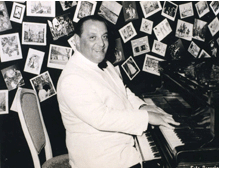 The improvement of transport between America and Europe revolutionized European music in the first half of the twentieth century. The ball room dances of the "old Europe", gave way to new dance rhythms from the Northern and Latin America, and the European began to listen to Tango, Rumba, Bolero, Slow Fox, the Quick Step, among other dances. From the old European dances, only the Waltz, in its different variations (English, French and Austrian), seemed to have managed to survive and compete well with the dances of the "new world". This American influence also came to Madeira - through new technologies of the early twentieth century, like discs and radio (for example the BBC) - being possible to find references to jazz music from the 20’s at least. Thus, the Daily News on May 1st of 1928, it was announced that "Batoret's Jazz Band played The improvement of transport between America and Europe revolutionized European music in the first half of the twentieth century. The ball room dances of the "old Europe", gave way to new dance rhythms from the Northern and Latin America, and the European began to listen to Tango, Rumba, Bolero, Slow Fox, the Quick Step, among other dances. From the old European dances, only the Waltz, in its different variations (English, French and Austrian), seemed to have managed to survive and compete well with the dances of the "new world". This American influence also came to Madeira - through new technologies of the early twentieth century, like discs and radio (for example the BBC) - being possible to find references to jazz music from the 20’s at least. Thus, the Daily News on May 1st of 1928, it was announced that "Batoret's Jazz Band played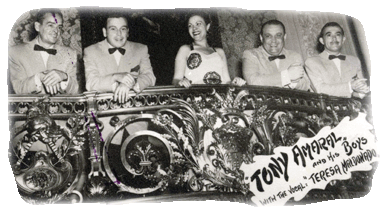 as backup during films at the Teatro Circo” The references to jazz continue during the 30’s, for example "The Swing Madders" that, - according to Vitor Sardinha in the book "Noites da Madeira" - interpreted jazz themes in 1939. One of the first Madeiran musicians to be influenced by the American "new music" and get huge success was the pianist and composer Tony Amaral. In the early 40’s, the pianist from Madeira played at Hotel Bellavista with a group formed by him - "Tony Amaral and his boys" - and in the middle of that decade performed in the night club "Flamingo”, a Madeiran club devoted to jazz. Participating in Tony Amaral’s there were musicians such as Max (vocals) - the famous Madeiran singer performed in the group till the end of the 40’s, Carlos Menezes (guitar), José de Freitas (bass) and Barrinha (drums). In 1946, the group moves to Lisbon where it plays in some of the major areas of entertainment of the Lisbon nightlife - Nina, Maxime, Clube as backup during films at the Teatro Circo” The references to jazz continue during the 30’s, for example "The Swing Madders" that, - according to Vitor Sardinha in the book "Noites da Madeira" - interpreted jazz themes in 1939. One of the first Madeiran musicians to be influenced by the American "new music" and get huge success was the pianist and composer Tony Amaral. In the early 40’s, the pianist from Madeira played at Hotel Bellavista with a group formed by him - "Tony Amaral and his boys" - and in the middle of that decade performed in the night club "Flamingo”, a Madeiran club devoted to jazz. Participating in Tony Amaral’s there were musicians such as Max (vocals) - the famous Madeiran singer performed in the group till the end of the 40’s, Carlos Menezes (guitar), José de Freitas (bass) and Barrinha (drums). In 1946, the group moves to Lisbon where it plays in some of the major areas of entertainment of the Lisbon nightlife - Nina, Maxime, Clube  Americano and Casino Estoril. The American influence was so strong in the group's music that, according to guitarist Carlos Menezes, in Lisbon some people thought that the group had come from America, not Madeira. Tony Amaral was also highlighted as a composer, having created some songs that are part of history. For example, his song "Noites da Madeira", where it is quite noticeable the northern american influence and other successes of the time such as, "Adeus Funchal", "Carolina", "Scarlet", "Tu, Solo Tu" and the famous "Bailinho da Madeira". With the exception of the last song, the written scores of these songs are available in the RTP Archive of Written Music in Lisbon. Americano and Casino Estoril. The American influence was so strong in the group's music that, according to guitarist Carlos Menezes, in Lisbon some people thought that the group had come from America, not Madeira. Tony Amaral was also highlighted as a composer, having created some songs that are part of history. For example, his song "Noites da Madeira", where it is quite noticeable the northern american influence and other successes of the time such as, "Adeus Funchal", "Carolina", "Scarlet", "Tu, Solo Tu" and the famous "Bailinho da Madeira". With the exception of the last song, the written scores of these songs are available in the RTP Archive of Written Music in Lisbon.
|